
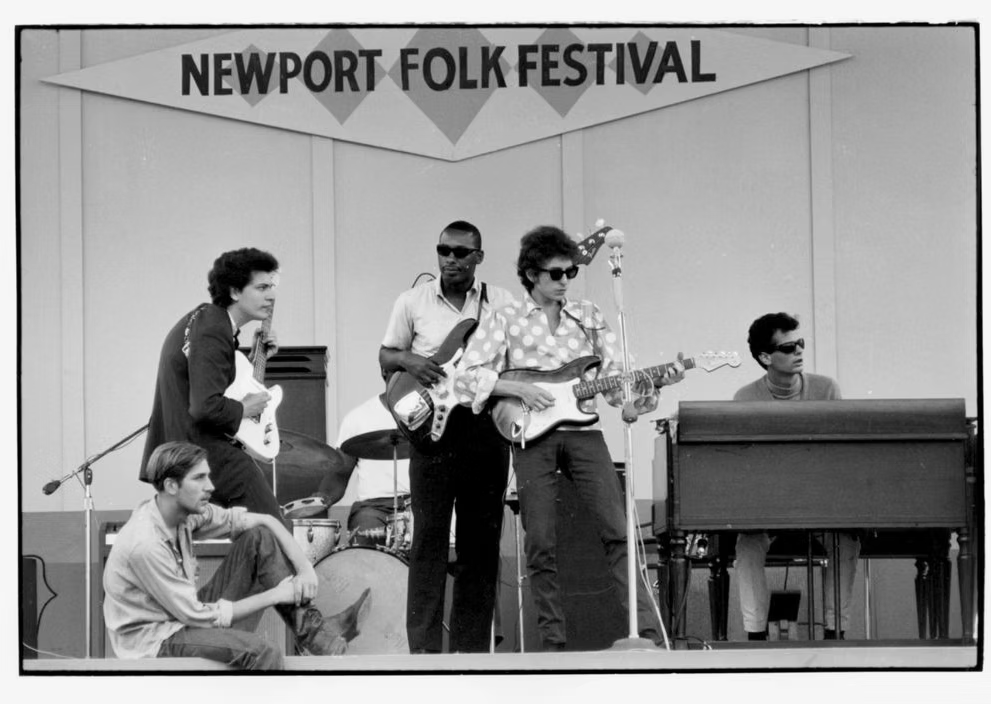
Newport Folk Festival represented the pinnacle and the unravelling of the purist folk tradition in America. Robert Gordon’s ‘Newport and the Great Folk Dream’, spanning 1963 to 1966, captures this on film, including the famous performance in which Bob Dylan, its crown prince ‘went electric’ – alongside a strong of new and old interviews. The film is a spiritual successor to 1967’s Festival and uses archival footage from the original documentary shot by director, Murray Lerner, and his team to display a more expansive representation of what the festival meant and the sounds it promoted, while, frankly, getting quite existential about folk music as a genre. I was rather excited about this, and similarly excited about the in-person Q&A from Joe Boyd at the BFI IMAX showing I attended in London for the Doc’N Roll Film Festival. He was the production manager at the festival’s 1965 edition and operated the sound board that night when Dylan plugged in his electric guitar. During his iconic career, he has worked with Pink Floyd, R.E.M., Eric Clapton, Aretha Franklin, Muddy Waters and even Stanley Kubrick on the ‘A Clockwork Orange’ soundtrack, alongside discovering and managing Nick Drake. He brought so much of my favourite music to life. Through the Q&A and a one-on-one chat in the cinema lobby, he provided incredible, first-hand insight into the state of folk in the mid-60s and helped me answer some questions the documentary raised.
The first half of Gordon’s documentary is devoted to illustrating what this ‘folk dream’ looked like. It would have been equally as fitting to call it ‘Newport and Pete Seeger’s Folk Dream’, as it explores Seeger’s own ideals and radical influences on the festival, from promoting the African American voice to splitting payment equally between all performers. Seeger, who was the ‘king’ to Dylan’s ‘prince’, infused the event with progressive politics and interpreted the folk tradition as one that was by the people, for the people. One interview noted how Seeger’s simple and familiar melodies and song structures promoted an inclusivity in music and message. His lyrics incorporated clear political meanings, and his songs were vehicles in which to deliver his thoughts. It’s an idea of folk music that permeated its culture in the 50s and 60s and led Dylan’s idol, Woody Guthrie, to emblazon his acoustic guitar with the message: ‘this machine kills fascists’.
The documentary winds its way through a host of performances of this purist ilk, featuring clips of Seeger himself and other figures of the Greenwich Village scene like Dave van Ronk, but the film finds its strength in pairing this with the performances of black artists and blues players like Howlin’ Wolf and Mississippi John Hurt, in the face of growing folk stardom. They receive substantial screen time, and it is much more representative of the actual festival where artists other than Bob Dylan played, if you can believe it. Amongst this, however, Dylan’s presence was described as a “riptide’ which claimed all attention“, while Boyd added: “In ’65 he was [the name on everybody’s lips]. Cars were driving past you with the radio turned up and you’d hear ‘Like a Rolling Stone’’.
Boyd’s anecdote spoke to a pop-cultural relevance that Dylan was garnering, wildly unfamiliar from his folk origins. The singer’s emergence and infamous electrification represented a tearing apart of the threads that Seeger had helped weave, and the genre’s identity was in crisis. Is folk music sung by a man lamenting working conditions and campaigning for the unions? While gaining mainstream notoriety, Dylan was simultaneously pivoting away from infusing such political ire into his music. ‘Masters of War’ was a seething admonishment of warmongers and expressed his generation’s passionate stance against the Vietnam war, while ‘A Hard Rain’s A-Gonna Fall’ encapsulated the same generation’s existential nuclear anxiety. He was once the voice of his generation, but by 1965 his lyric-writing took on a more poetic and abstracted form while taking less overt interest in politics. What is ‘Like a Rolling Stone’, if not an admittedly incredibly well-written, but puerile Edie Sedgwick diss-track?
Mike Bloomfield, who played in Dylan’s band in 1965, shared his own folk dream that was in wild opposition to what prevailed at the time. He said: “rock and roll is folk music”. He thought like the blues player Big Bill Broonzy, who quipped: “All music is folk music. I ain’t ever heard a horse sing a song.” Folk music is a concept perceived differently by all, and Dylan and Bloomfield’s ‘folk dream’ was different from Seeger’s, but was equally as valid.
Joe Boyd made an important distinction in his Q&A, emphasising the sheer volume the band played at that night. In a fascinating retelling, he said:
“Mike [Bloomfield] was a wonderful guy, wonderful player. But he was so excited. He was really psyched. And the Chambers brothers had an electric guitar on that same stage the day before. It wasn’t very loud. Why was Maggie’s Farm so loud? I kind of look back and ask myself that. [I gave] Paul Rothschild, who was the great producer I asked to come up and mix the sound, a pink magic marker and he marked the levels for Dylan at the sound check so he could push them up in the dark, right to the level that we got at the sound check. Bloomfield cranked his [amp] right up, and I think that at the sound check, Paul had to push Dylan and the drum kit and the other instruments up beyond where he might have otherwise, just to match the sound of Bloomfield’s guitar. And so, like a lot of things in history, there’s some little detail that changes everything, and the volume just completely excited the younger crowd in the audience and horrified the children. I don’t think Dylan was [provoking Bloomfield]. I don’t think he thought, oh, it’s got to be the loudest thing anybody’s ever heard – but it was. I mean, it was really loud.”
Boyd’s interpretation of the events shows the thin, subjective lines that define folk music, or any genre. Sometimes a genre doesn’t have clear parameters but carries a certain feeling that comes to categorise it. Take post-punk which is so broadly defined as to include The Fall and Talking Heads, who frankly do not sound remotely similar, but are united in the punk ethos they asserted. My take-away from ‘Newport and the Great Folk Dream’ is that folk exists in a similar vein to post-punk in this regard, as many think the defining feature of folk is inclusion, and that it ought to appeal to all.
Boyd said: “When you plug in a guitar, it’s no longer communal – it separates. An [electric] guitar belongs on a stage, being projected out at a room full of dancers, or an audience – us up here and you out there – whereas an acoustic guitar can be more inclusive. There’s a symbolism there.”
This is where Dylan and Bloomfield seemed to corrupt folk’s deeply ingrained philosophy by imposing their own vision onto the genre’s biggest stage. The film’s achievement is to hold these visions in tension. The first half builds the dream, the second half watches it fracture (or evolve), all while Gordon resists the temptation to mourn. Instead, he asks the audience to sit with the question at the heart of the Newport story – what is folk music, and whose ‘folk dream’ gets to be validated?
This is the documentary’s underlying question, but it overtly conveys the character of Newport festival. Gordon shows blues musicians playing electric guitars around acoustic guitar-playing folk singers (before Dylan’s 1965 performance), and groups of youngsters joining together to share different musical styles at the campsite as they sat on bonnets under the sun. Newport wasn’t merely the stage where the argument of identity took place; it was the breeding ground of the evolution which brought these different ideas together and changed everything, forever.
You can follow Doc’n Roll Film Festival on their socials: Instagram | YouTube | Bluesky
Words by Thomas Hill
Keep up to date with all new content on Joyzine via our
Facebook | Bluesky | Instagram | Mailing List